
The post explains a couple of interesting timer circuits customized as per individual requirements.
The first one is a kind of week/day programmable timer circuit for actuating a motor for a predetermined time only during certain selected days of the week, while the second timer circuit is for alerting a lecturer regarding the finish of the allotted time of his/her class period.
The ideas were requested by Mr. Stevan and Mr Ilman respectively.
Circuit Request#1
I spend more than 20 hours on your site, searching for a circuit I need...
My knowledge is not enough to figure which circuit I can use and I tried with many of them... If you have time, I would be very grateful if you could help me and design circuit.
我需要计时器电路将允许我选择哪一个for how long it will stay ON (3-10 sec) and how many times it will repeat that action during 7 days (1-7 times i.e. once in a week, twice in a week, every day etc). I need it for controlling 9-12V electrical motor.
Circuit Diagram
Circuit Operation
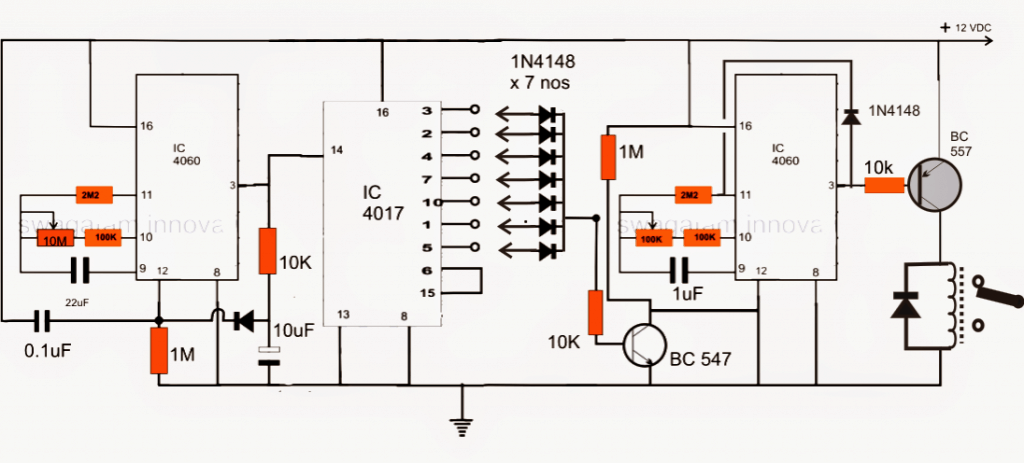
As shown in the above week day programmable timer circuit, the IC 4060 at the left side is wired up as a24 hour timer circuit.
The time length is determined by the 22uF capacitor and the 10m pot. A suitable fixed value may be selected for these two components for getting the specified time delay.
The 22uF capacitor must be non-polar low leakage type of capacitor and the resistors should be MFR 1%
The output is received from pin#3 of the above IC, which goes high as soon as the set time elapses. This results in a short pulse to pin#14 of the IC 4017 which is configured as a 7 stage counter divider here.
With every pulse after the preset 24 hours interval, the IC 4060 also resets itself via the diode connected across its pin#3 and pin#12.
The IC 4017 output functions as a week timer where its 7 outputs shift (become high) from pin3 to pin6 sequentially in response to the above 24 hour pulses, depicting the 7 days of the week.
The right hand side IC 4060 is configured as short duration timer for activating the motor which may be connected with the shown relay contacts.
This stage is integrated with the IC 4017 stage through the shown 7 1N4148 diodes. Depending on what days the motor needs to be switched ON, only those relevant diodes are connected with the 4017 outputs, rest of the diodes are kept unconnected.
After all these connections, when power is switched ON, the left hand side 4060 triggers and forces the outputs of the IC 4017 to become high in sequence every after 24 hours.
Depending upon the connections of the diodes, the right hand side 4060 IC gets switched ON only on those selected days of the week via the BC547 transistor which grounds its reset pin#12 on receiving the signal from the IC 4017 relevant outputs.
This prompts its pin#3 to go low activating the preceding relay driver stage and the motor.
The above stage stays activated until the set time elapses when its output becomes high inhibiting the relay driver sage from base drive thereby stopping the motor. The high from the pin 3 also latches the IC via the diode to its pin11. The time interval may be fixed by adjusting the given 100k pot
The whole operation resets on the next pulse from the 24 hour 4060 timer stage.
The operation thus repeats as per the programming done on the three ICs.
Circuit Request#2
I need circuit for time limiter to use for public speaking.
Say if a teacher has one hour to speak in the class then the timer will show a green light starting from 60 minute then counting down to 0, but before finish the yellow light will turn on to remain a teacher that the time almost finish, it can be 3 minutes before to 0, finally when the time is over the red light will be on, it means that time for the teacher is finish.
Circuit Operation
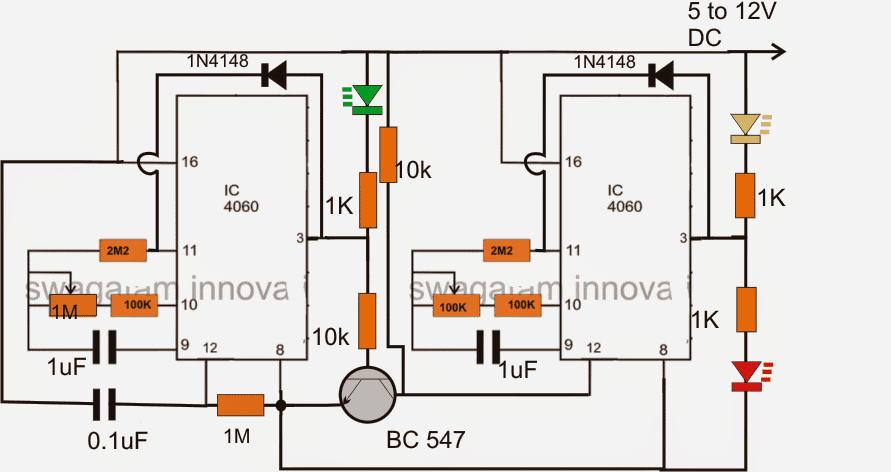
The above cascadedtwo stage sequential timer circuitis rather simple with its configuration Two 4060 ICs are linked with each other to form a sequential timer configuration.
The left IC is rigged as a 57 minute timer circuit while the right hand side IC as a 3 minute timer circuit.
When switched ON the left IC starts counting (green LED ON) until 57 minutes have elapsed which makes its pin3 go high, shutting off the green LED
This triggers the connected BC547 transistor which now grounds pin12 of the second 4060 IC prompting it to start its 3 minute counting process.
This activates the yellow LED indicating the last 3 minutes being counted, until it gets over shutting off the yellow LED and switching ON the RED LED.
The diodes across pin3 and pin11 of the ICs keep the ICs latched until the circuit is switched OFF and switched ON for initiating the next cycle.
Using LDR for Detecting Day Night Periods
The fundamental strategy is to produce an electronic signal that turns high once the sun sets and turns low as dawn sets in, followed by counting the transitions. Photocel1 LDR1 is positioned to sense the sun light . This must be targeted at the north skies instead of the sun directly, thus it is going to see practically the same thing during clear skies and also over cast ones. R1 is placed for controlling sensitivity of the LDR.
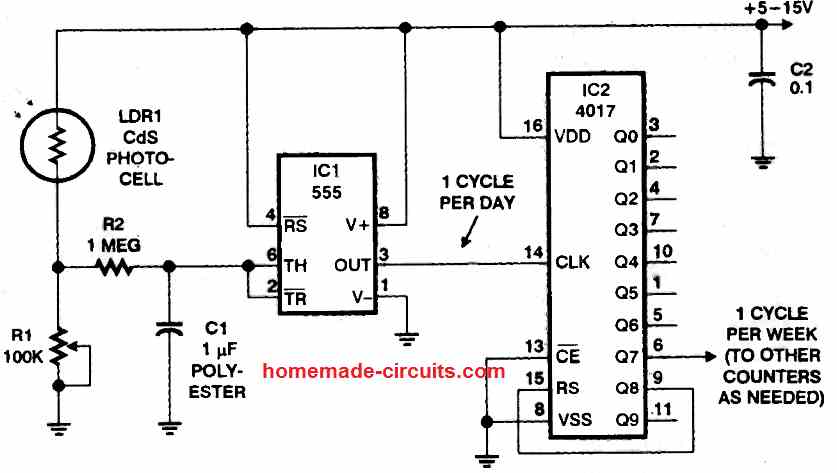
A good way to fine-tune it, without dealing with a complete day/night period, is to hold off until around 10 minutes following sunset, at the center rotation between day and night, and alter R1 in order that the voltage across it is half the supply voltage.
Later, examine that the IC1 output is high during night and low during the daytime. A low-pass filter is created using R2 and C1 , producing roughly a 1-second hold up to ensure the circuit doesn't get rattled with lightning flashes or various other brief light variations.
A 555 timer, ICI, is employed like a light level sensor; instead of the comparator circuit. The 555 offers hysteresis, which implies that the trigger ON voltage will be greater than the trigger-off voltage.
This prevents the circuit from "stuttering" to and fro between off and on during transition thresholds. The second IC in the circuit (IC2) is a 4017 (CD4017) CMOS decade counter.
Simply by hooking up output Q8 to the reset input, we allow it to count upto 7 and then start off yet again, therefore its output creates a solitary day-long pulse each week. You are able to supply this to additional counters in order to calculate even extended time periods.
For instance, incorporating a divide-by-four counter (like a 4017 with Q5 attached to reset) could give you a period of 28 days


Dear Swagatam, thank you very very much for this circuit, explanation and your time! I have just two additional question…
You wrote "Depending on what days the motor needs to be switched ON, only those relevant diodes are connected with the 4017 outputs, rest of the diodes are kept unconnected" – Does it mean that motor can be turned ON for example 2nd day and 4th day?
My second question is about +12V and Ground because it looks like it's short circuited?
Thanks again…
Dear Stevan,
Thanks! Yes the motor can be switched ON on any particular selected days of the week.
I have corrected the diagram, the short is removed now.
Thanks Guru …
It works by little bit correction in pin 8 (IC2) should be opened from ground.
My next question is about the formula for resistors and capacitor that connect to pin 9 and 10, so I can calculate the time needed.
Thanks for your help.
Gumilar
Gumilar, if you disconnect pin8 of any of the ICs will result in malfunction of the circuit, because it's the ground pin of the ICs.
For the formula you may refer to this article:
//www.addme-blog.com/2012/01/how-to-make-simple-versatile-timer.html
Respected Sir,
I love your blog. I spend a lot time for searching circuit for countdown timer switch for 120v but I cannot find it. Can you please upload one or can guide me for the same?
Thank You
shah
kristin, please provide more details about your requirement, i'll try to help.
Dear Swagatam Majumdar
Im Shouquat. I like ur work. May I know, How to check the 7 days daily circuit? Its working or not. Because if its working but wait for long time to see the result. Can u give me some idea to check the circuit quickly? Regards,
Would love to see a circuit that turns an LED on for 4 hours, then sleeps for 20 hours. Part of my adventures in making an LED candle setup.
You can probably try the following design:
//www.addme-blog.com/how-to-make-simple-programmable-timer/
For the 20 hour stage in the circuit use many 1uF non-polar cps in parallel for C1
Love all your work!
Such blessing to many.
Old ET. From tubes to transistors and ICs.
Enjoying everything.
Walt. S.
Thanks a lot, Glad you liked my work, please keep up the good work!
las publicaciones son excelentes,por lo básicas que son ,me han ayudado a comprender el funcionamiento de muchos aparatos electrónicos y mecánicos de la manera mas simple,por lo que esto me permitido poder interpretar planos y maquinas mas complejas.
bueno no puedo escribir muy bien Ingles pero si pudo traducir perfectamente.
¡Gracias! Realmente aprecio sus pensamientos y me alegro de que le hayan gustado mis artículos, ¡sigan con el buen trabajo!
Hello,
Thank you very much, the first circuit is perfect for a project I am working on. I’m relatively new to circuits and I wanted to try to understand what is happening a little more. Could you explain the purpose of some of the components for me?
How does the 10M pot change the calculations for the frequency for the 4060? Every time I try to use the formula you gave in the 4060 explained article, either to calculate the frequency from what you gave or try to calculate the resistance from the frequency I want, my answers never match up.
的目的是什么二极管在销# 3和pin#12? When I was looking through that 4060 article, it didn’t seem like a diode was necessary, is it still?
What is the purpose of the 10 uF polar capacitor between pin#3 and the ground?
Sorry for all the questions, I’m just hoping to learn more.
You are welcome, and appreciate your feedback.
The 10M forms the timing resistor for the complementing timing capacitor Ct. The Ct is charged and discharged alternately via Rt with the help of the actions of the IC internal gates connected with the Rt, Ct.
In the formula you must use Ct in Farads, and Rt in Ohms.
The diode causes instant resetting and reverting pin#3 to zero so that the next count is able to start from a perfect zero, and this ensures accurate uniform timing pulses from the IC 4060.
电容器确保销# 14获得适当的logic from pin#3 and the IC 4060 is erset after some delay, allowing pin14 of the IC 4017 to implement the changeover correctly.